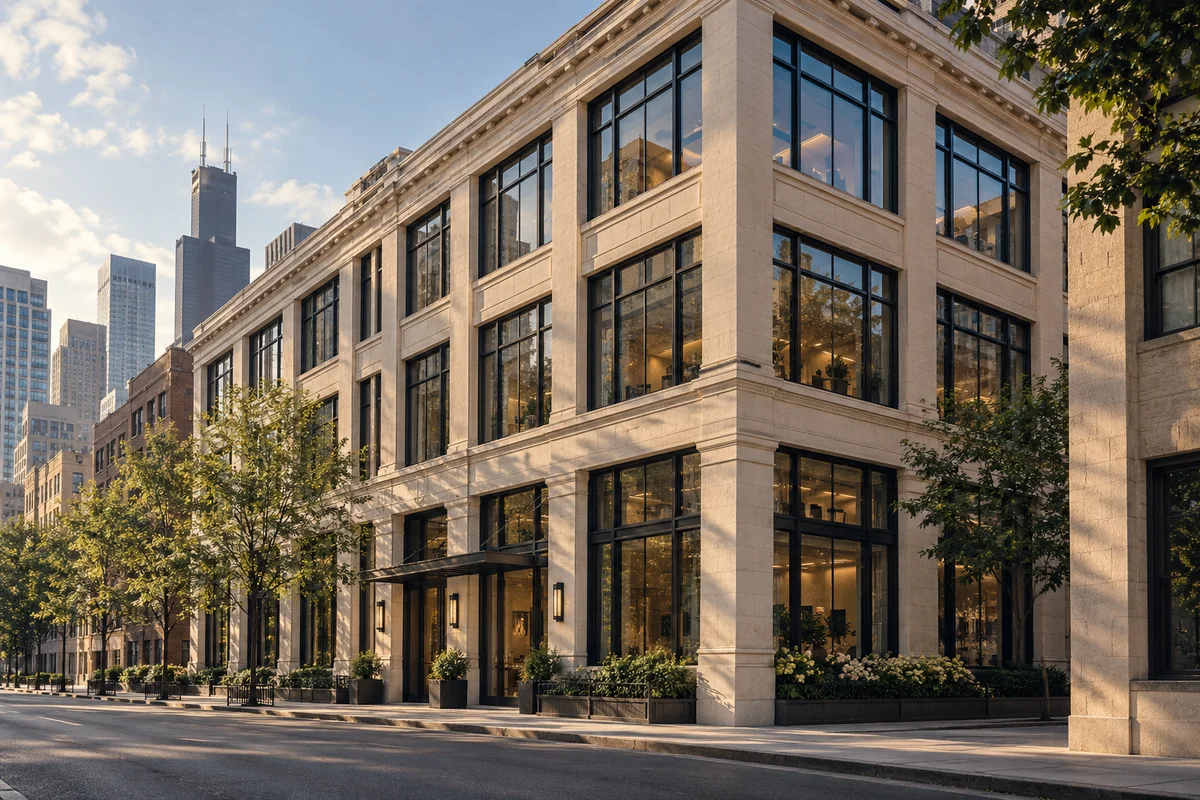
Office value can disappear from cash flow long before it disappears from a seller’s NOI presentation. This hypothetical acquisition includes a major lease expiration after year one and a funded replacement program. The investor must pay for the next tenant while the space produces less income.
The thesis is a competitive office building after a defined leasing and physical program. The price should compensate for that work, vacancy, and capital. Current occupancy and face rent do not establish what equity will receive during the transition.
All properties, tenants, leases, prices, costs, rates, and outcomes in this case are hypothetical. They are teaching assumptions, not market comparables, actual lender offers, or Jaken-funded transactions.
Acquisition assumptions and balanced funding
| Initial use | Amount |
|---|---|
| Purchase | $4,000,000 |
| Closing and financing costs | $120,000 |
| Physical work | $300,000 |
| Leasing capital | $600,000 |
| Opening operating liquidity | $250,000 |
| Contingency | $150,000 |
| Total uses | $5,420,000 |
| Initial selected debt | $2,500,000 |
| Required equity | $2,920,000 |
Underwrite the expiration before capitalizing the rent
Assume current NOI is $450,000. A 15,000-square-foot tenant paying $25 annual gross rent per square foot contributes $375,000 rent and leaves after year one. The model assumes $75,000 expense avoidance during the stipulated vacancy, so transition NOI is $150,000: $450,000 less $375,000 plus $75,000. These are invented terms, not an actual Chicago lease or expense benchmark.
The buyer funds $500,000 of tenant improvements and $100,000 commissions and related leasing capital, totaling $600,000, plus $300,000 separate building work. Accounts are included in initial uses and spent during years one through three. Obtain actual delivery condition, work letter, commission agreement, scope, and timing before relying on them.
BXP’s 2025 filing discusses tenant credit, concessions, improvements, and other leasing economics. It is a primary office-ownership reference, not evidence of this building’s achievable rent or leasing cost. BXP 2025 Form 10-K
The operating path assumes $300,000 NOI in year three, $420,000 in year four, and $450,000 in year five. It includes the modeled revenue and expense consequences of replacement. Do not simply add full new rent to the old NOI without removing the departing lease and including new costs.
Two financing structures
The selected illustration is $2,500,000 at 7.0%, with monthly payments, 25-year amortization and a five-year maturity. Monthly payment is $17,669; annual debt service is $212,034. Modeled principal after 60 payments is $2,279,054. The full commitment is assumed funded at closing; any restricted capital is tracked separately.
The alternative is $3,000,000 at 9.0% interest-only for 2 years, with $270,000 annual interest and $2,420,000 initial equity against the same uses. Principal remains $3,000,000 at its stipulated maturity without paydowns. The closing-cost allowance is held equal only to isolate structure; real proposals need their own fees, reserves, conditions, and approval.
The alternative lowers initial equity by $500,000 but increases interest and requires a two-year exit precisely when the property has only $150,000 modeled NOI. A takeout based on the restored $450,000 would ignore the actual maturity condition.
The selected loan leaves more equity and a five-year term. Its assumed availability still needs real underwriting of the expiration, sponsor, leasing budget, and cash reserves. A lender can impose a different income basis or reserve structure. Neither proposal is an actual offer.
The OCC handbook provides primary context for income-producing property and construction-funding analysis. The request should show the expiration, landlord obligations, cash burn, and exit together. OCC CRE handbook
Five-year cash and funding model
| Year | NOI | Debt service | Recurring replacements | Raw operating cash | Opening reserve used | Cash available before owner allocation |
|---|---|---|---|---|---|---|
| 1 | $450,000 | ($212,034) | ($30,000) | $207,966 | $0 | $207,966 |
| 2 | $150,000 | ($212,034) | ($30,000) | ($92,034) | $92,034 | $0 |
| 3 | $300,000 | ($212,034) | ($30,000) | $57,966 | $0 | $57,966 |
| 4 | $420,000 | ($212,034) | ($30,000) | $177,966 | $0 | $177,966 |
| 5 | $450,000 | ($212,034) | ($30,000) | $207,966 | $0 | $207,966 |
The annual table separates funded initial leasing capital from later recurring replacement expense. It does not deduct the $600,000 again from yearly cash because that account is already funded by acquisition sources. The recurring replacement amount is deposited and spent each year.
Operating deficits reduce opening liquidity before any further contribution. Positive cash is assumed released at year-end for the return model, while a real lender or ownership agreement may retain it. The model cannot claim actual member distributions without that additional allocation.
Monthly detail is essential for office leasing. Improvement invoices, allowance reimbursement, commissions, free rent, possession, and paid-rent commencement can occur at different times. A positive year-end reserve does not prove an early contractor invoice can be paid.
Additional operating downside
A separate stress assumes $50,000 NOI and $300,000 additional unbudgeted capital in one stressed year. Cash after selected debt, recurring replacements, and that extra capital is ($492,034). Against the full opening operating/contingency balance of $400,000, the model uses $400,000 and requires $92,034 additional equity. This is a separate stress, not a claim that the same reserve remains intact after base-case draws.
The separate stress represents lower collections and another $300,000 of leasing or building scope beyond the initial funded accounts. Compare it with committed capital and remaining liquidity, not only the projected terminal return.
The SEC-filed work letter illustrates that allowance use, delivery, documentation, and payment conditions can be negotiated explicitly. It is a primary document example rather than the assumed terms of this fictional office lease. SEC work-letter example
Test longer downtime and a smaller tenant pool. A large floor plate, building systems, access, amenities, parking, or delivery condition can affect leasing. This case supplies no current Chicago office-rent or vacancy forecast; the subject competitive set must support the plan.
Concrete five-year exit and returns
Assume end-of-year-five sale with forward NOI of $450,000 and 2.0% selling costs. The scheduled-maturity model assumes no additional prepayment charge; actual payoff, taxes, and fees need confirmation.
| Exit calculation | Base cap | Higher-cap sensitivity |
|---|---|---|
| Exit cap | 8.5% | 9.5% |
| Gross price | $5,294,118 | $4,736,842 |
| Selling costs | $105,882 | $94,737 |
| Loan balloon | $2,279,054 | $2,279,054 |
| Net equity sale proceeds before reserve return | $2,909,181 | $2,363,051 |
| Remaining reserve returned | $307,966 | $307,966 |
| Total positive equity cash over hold | $3,869,013 | $3,322,883 |
| Total contributed equity | $2,920,000 | $2,920,000 |
| Equity multiple | 1.325× | 1.138× |
| Annual model IRR | 6.20% | 2.82% |
The selected five-year sale assumes the replacement income is performing and the capital program is complete. The higher-cap sensitivity changes pricing only, leaving the same operating path. An unfinished or partly leased building needs a separate income and cost scenario.
The equity return includes all closing, physical, leasing, and reserve capital, with any modeled further contributions. Remaining opening liquidity returns only if unused. The model is before income taxes, investor-specific fees, and the governing waterfall, and assumes no extra prepayment charge at scheduled maturity.
Compare the result with the investor’s required return and risk capacity. A sale price above purchase does not establish a profitable acquisition when substantial work and leasing were needed. The relevant basis is total funded investment and actual cash timing.
Diligence and investment decision
Before the inspection deadline, verify the existing lease and amendments, tenant notices, options, contraction rights, current payment, deposits, and actual landlord delivery obligations. Investigate whether renewal is feasible before assuming replacement is the only path.
Compare a supported renewal proposal with replacement on dated net cash. A lower face rent can preserve more value if it avoids downtime, allowances, commissions, and uncertain delivery. The decision should not be made from headline rental growth alone.
Obtain contractor and leasing input for the actual floor and building, including systems, compliance, permitted use, capacity, and shared improvements. For a Chicago-area address, identify the exact municipality and relevant records. Do not assume an existing office use or past work resolves every proposed alteration.
Approve only if the complete delivery program, credible tenant alternatives, loan conditions, and monthly liquidity are fundable. Retain a defined ceiling for additional capital and a decision point if leasing is behind plan. A larger bridge can make initial equity look attractive while placing maturity in the weakest operating year.
After closing, report qualified leasing activity, signed terms, possession, improvements, paid rent, capital commitments, and reserve burn. Reconcile NOI to cash after leasing and debt. The investment is a business plan through the next tenant, with a price that must account for the full cost of reaching that tenant.
At this asking-price and cost basis, an investor requiring ten-percent annual return would reject the base forecast even before adding further uncertainty. The building’s restored NOI does not overcome the full leasing investment quickly enough. Negotiate a supported lower basis or different lease economics rather than remove improvements, commissions, or downtime from the model to reach the hurdle.