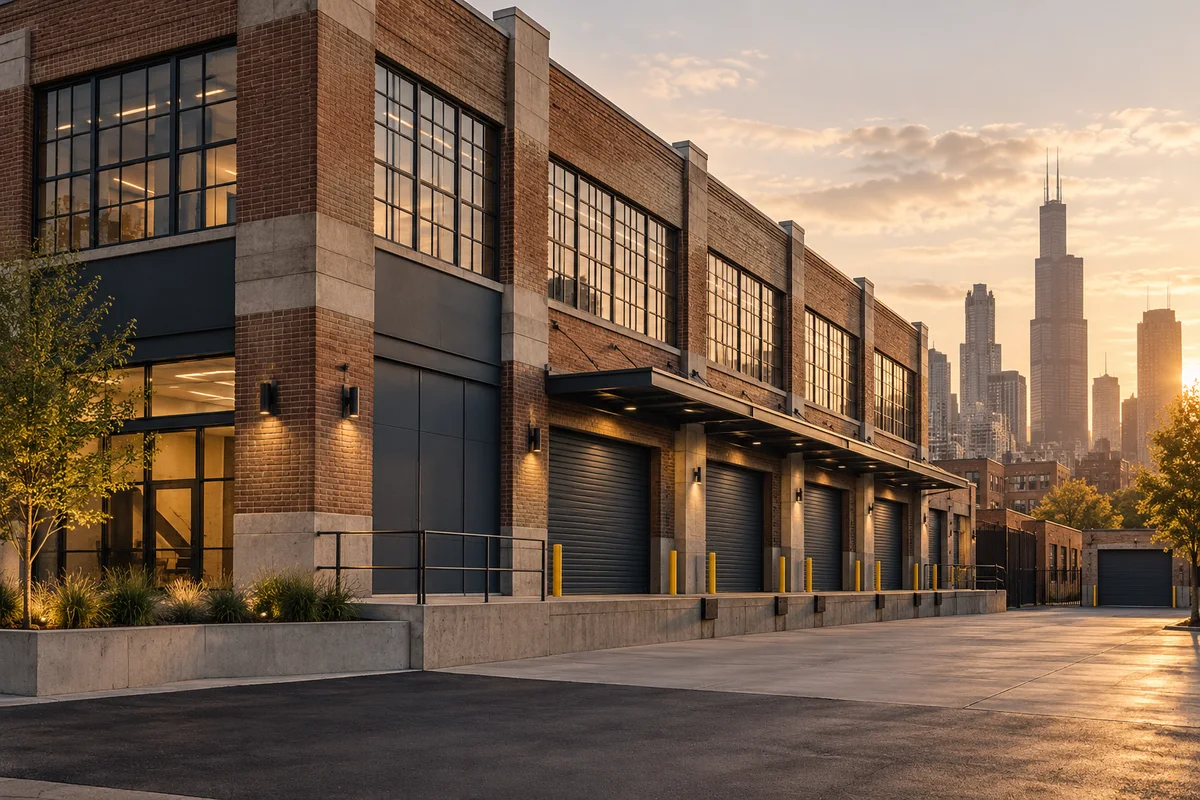
Buying an operating storage property and adding units creates an acquisition risk and a development risk at the same address. Existing collections help pay bills but do not prove that new rentable area will lease at the advertised rate. This hypothetical case acquires a functioning facility and adds capacity through a defined capital program.
The thesis is incremental demand that supports expansion after construction, promotions, marketing, operating costs, and financing. The investor should evaluate the expansion separately before combining it with the existing property’s cash.
All properties, tenants, leases, prices, costs, rates, and outcomes in this case are hypothetical. They are teaching assumptions, not market comparables, actual lender offers, or Jaken-funded transactions.
Acquisition assumptions and balanced funding
| Initial use | Amount |
|---|---|
| Purchase | $3,500,000 |
| Closing and financing costs | $120,000 |
| Physical work | $1,200,000 |
| Leasing capital | $80,000 |
| Opening operating liquidity | $200,000 |
| Contingency | $200,000 |
| Total uses | $5,300,000 |
| Initial selected debt | $2,800,000 |
| Required equity | $2,500,000 |
Model occupied units and achieved revenue
Assume an existing facility with $600,000 effective annual revenue and $300,000 operating expenses, producing $300,000 first-year NOI. The expansion temporarily reduces year-two NOI to $280,000 through construction interference and operating costs. Projected NOI subsequently reaches $390,000, $480,000, and $520,000. Every amount is hypothetical.
The final operating illustration assumes $850,000 effective revenue and $330,000 expenses. This is revenue actually expected after concessions, vacancy, and collection loss; multiplying nominal street rent by every new unit would overstate income. Separate existing and new units by size, climate control, access, and competing supply where those distinctions affect demand.
The $1,200,000 physical account includes the stipulated expansion scope; $80,000 leasing and marketing capital supports initial occupancy. Both are funded at closing and spent through years one to three. A real feasibility study must verify site capacity, access, drainage, utilities, fire and life safety, construction scope, approvals, and contingency rather than infer feasibility from vacant land.
Public Storage’s annual filing describes its actual storage operations and development-related activity. It provides a primary operating reference for the asset class, not evidence that this hypothetical Chicago-area site has demand or that its costs match a public company’s portfolio. Public Storage 2025 Form 10-K
Two financing structures
The selected illustration is $2,800,000 at 7.5%, with monthly payments, 25-year amortization and a five-year maturity. Monthly payment is $20,692; annual debt service is $248,301. Modeled principal after 60 payments is $2,568,511. The full commitment is assumed funded at closing; any restricted capital is tracked separately.
The alternative is $3,400,000 at 10.0% interest-only for 3 years, with $340,000 annual interest and $1,900,000 initial equity against the same uses. Principal remains $3,400,000 at its stipulated maturity without paydowns. The closing-cost allowance is held equal only to isolate structure; real proposals need their own fees, reserves, conditions, and approval.
The larger interest-only loan preserves $600,000 initial equity but creates a three-year balloon before the final projected income is achieved. Its third-year NOI is $390,000, not $520,000. A takeout must be sized at that time using accepted income and remaining work.
The selected amortizing structure requires more equity and has a five-year term. It is still conditional on lender acceptance of expansion and operating risk. The model assumes all debt funded initially to make the arithmetic transparent; an actual construction facility normally needs a distinct draw and interest schedule reflecting its documents.
The OCC’s construction and commercial lending discussion is the primary framework for evaluating budget, disbursement, repayment, and completion risk. It does not establish that a particular lender will offer either hypothetical structure. OCC CRE handbook
Five-year cash and funding model
| Year | NOI | Debt service | Recurring replacements | Raw operating cash | Opening reserve used | Cash available before owner allocation |
|---|---|---|---|---|---|---|
| 1 | $300,000 | ($248,301) | ($25,000) | $26,699 | $0 | $26,699 |
| 2 | $280,000 | ($248,301) | ($25,000) | $6,699 | $0 | $6,699 |
| 3 | $390,000 | ($248,301) | ($25,000) | $116,699 | $0 | $116,699 |
| 4 | $480,000 | ($248,301) | ($25,000) | $206,699 | $0 | $206,699 |
| 5 | $520,000 | ($248,301) | ($25,000) | $246,699 | $0 | $246,699 |
Annual recurring replacement funding is deposited and spent in the same year. The capital accounts funded in acquisition uses pay the stipulated project and initial leasing costs; charging them again below NOI would count the same expense twice. Unspent opening operating and contingency funds remain subject to actual restrictions.
Evaluate the incremental project using a separate comparison. If an unchanged facility could sustain $300,000 NOI while the completed version reaches $520,000, the terminal difference is $220,000. Dividing that amount by $1,280,000 physical and initial leasing investment gives approximately 17.19%. This is a simplified stabilized incremental yield before disruption, financing, timing, and other changes. It is not the full property’s IRR or a forecast.
Use a monthly absorption schedule for new units. Promotions can improve physical occupancy while reducing collected revenue. A unit occupied for a discounted first month and a unit paying full ongoing rent are not economically equivalent. Reconcile leads, move-ins, move-outs, discounts, delinquency, and achieved rent rather than treating occupancy as the only operating target.
Additional operating downside
A separate stress assumes $170,000 NOI and $300,000 additional unbudgeted capital in one stressed year. Cash after selected debt, recurring replacements, and that extra capital is ($403,301). Against the full opening operating/contingency balance of $400,000, the model uses $400,000 and requires $3,301 additional equity. This is a separate stress, not a claim that the same reserve remains intact after base-case draws.
The separate stress combines lower NOI with $300,000 additional capital beyond the initial project. It represents an illustrative mix of weaker demand, delay, and cost overrun rather than an asserted construction outcome. The funding calculation identifies how much the opening pool covers and how much additional equity is required.
A bigger building can increase fixed operating costs before new revenue arrives. Identify staffing, security, utilities, software, insurance, maintenance, taxes, and property-management costs attributable to the expansion. Test the facility with slower move-ins and increased move-outs from existing units at the same time.
Before buying the site, commission appropriate environmental diligence. EPA’s All Appropriate Inquiries information explains a federal diligence framework; it does not promise that a property is uncontaminated or establish every defense without additional conditions. Historical site uses and the expansion’s ground disturbance need qualified review. EPA All Appropriate Inquiries
Concrete five-year exit and returns
Assume end-of-year-five sale with forward NOI of $520,000 and 2.0% selling costs. The scheduled-maturity model assumes no additional prepayment charge; actual payoff, taxes, and fees need confirmation.
| Exit calculation | Base cap | Higher-cap sensitivity |
|---|---|---|
| Exit cap | 7.5% | 8.5% |
| Gross price | $6,933,333 | $6,117,647 |
| Selling costs | $138,667 | $122,353 |
| Loan balloon | $2,568,511 | $2,568,511 |
| Net equity sale proceeds before reserve return | $4,226,155 | $3,426,783 |
| Remaining reserve returned | $400,000 | $400,000 |
| Total positive equity cash over hold | $5,229,650 | $4,430,278 |
| Total contributed equity | $2,500,000 | $2,500,000 |
| Equity multiple | 2.092× | 1.772× |
| Annual model IRR | 16.35% | 12.50% |
The five-year sale assumes $520,000 supportable forward NOI, completed work, and no unmodeled remaining delivery obligation. The higher-cap scenario changes terminal pricing while preserving the same operating path. A slow expansion requires a new income schedule and cannot be represented solely by that cap sensitivity.
The full equity basis includes acquisition, fees, project costs, leasing, opening liquidity, and contingency. The table assumes annual release of positive cash, returns unused opening reserves only once, and deducts the actual modeled balloon. It is before income taxes, negotiated sponsor compensation, and ownership allocation.
A buyer may review in-place unit-level results, achieved rents, promotions, cancellations, collections, and competing supply. A recently filled expansion with temporary discounts needs different analysis from durable mature revenue. Preserve the information that explains the transition.
Diligence and investment decision
Approve only after the existing business is independently supportable and the incremental project clears a defined return and liquidity test. Separate the purchase decision from the expansion commitment where contracts and approvals allow that option. Acquiring an operating facility does not obligate an investor to pursue an uneconomic addition.
Obtain independent construction pricing, verified approvals, competing supply evidence, unit-level operating data, and a funded monthly schedule. Identify the decision date at which a weaker leasing result would justify slowing further capital expenditure.
After closing, report existing and new cohorts separately. Compare actual construction commitments, remaining contingency, achieved revenue, operating costs, reserve balances, and refinance readiness against the approved plan. The investor needs to know whether expansion is creating valuable recurring income or merely more rentable area.
Review achieved revenue by move-in cohort. A new cohort’s introductory discount may expire after the reporting month, while its move-out behavior remains untested. Compare recurring collected rent after promotions with the expansion’s approved assumptions before declaring stabilization.