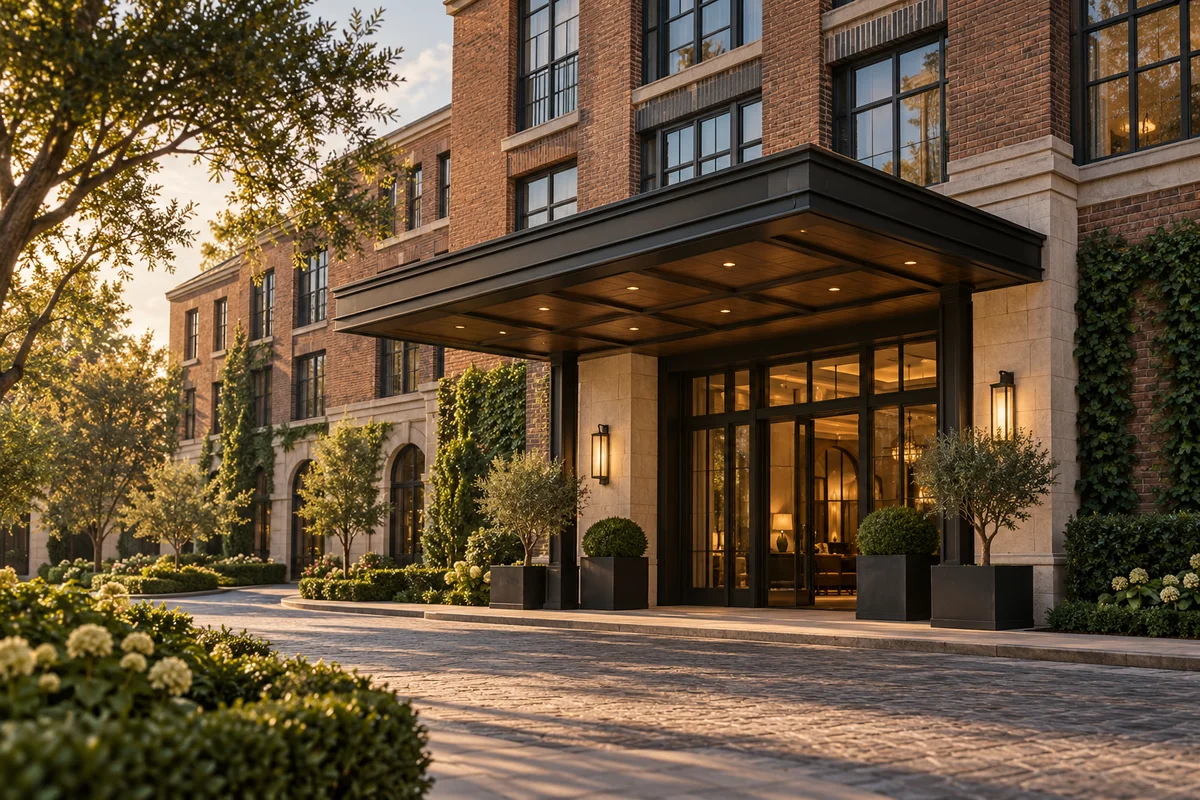
A hotel is an operating business tied to real estate. A renovation can change room quality and revenue potential while reducing available rooms and consuming cash. This hypothetical acquisition therefore models disruption before stabilization instead of applying a target revenue multiple to the purchase price.
The thesis is improved operating performance after a defined renovation and reopening program. It requires evidence about demand, pricing, brand and management arrangements, labor, project scope, and working capital. A business plan based only on a higher average daily rate leaves most of the investment unexplained.
All properties, tenants, leases, prices, costs, rates, and outcomes in this case are hypothetical. They are teaching assumptions, not market comparables, actual lender offers, or Jaken-funded transactions.
Acquisition assumptions and balanced funding
| Initial use | Amount |
|---|---|
| Purchase | $6,000,000 |
| Closing and financing costs | $200,000 |
| Physical work | $2,000,000 |
| Leasing capital | $100,000 |
| Opening operating liquidity | $500,000 |
| Contingency | $400,000 |
| Total uses | $9,200,000 |
| Initial selected debt | $4,000,000 |
| Required equity | $5,200,000 |
Reconcile rooms, revenue, and owner cash
Assume 100 rooms and a 365-day illustrative year. At 65% occupancy, 23,725 room nights sell. At a $160 average daily rate, room revenue is $3,796,000. Add $204,000 other revenue for $4,000,000 total revenue. Hypothetical operating costs of $3,050,000 produce the $950,000 terminal NOI used here, before the separately modeled $100,000 recurring replacements and debt service.
This definition includes the stipulated property operating expenses and management charges in the $3,050,000. Verify an actual hotel’s reporting conventions before comparison: revenue, departmental profit, management fees, property expenses, owner capital, and debt may appear on different schedules. Do not substitute a headline operating measure for cash distributable to ownership.
Initial NOI is $300,000, falls to $150,000 during renovation, and rises through $600,000 and $850,000 to $950,000. These are hypotheses rather than Chicago hotel market statistics. The case assumes $2,000,000 physical work and $100,000 initial reopening and marketing capital, funded at acquisition and spent in years one and two.
Host Hotels’ annual filing provides a primary example of hotel ownership, operations, and capital-related disclosures. Its portfolio experience cannot validate this independent property’s occupancy, renovation budget, or value. Host Hotels 2025 Form 10-K
Two financing structures
The selected illustration is $4,000,000 at 7.5%, with monthly payments, 25-year amortization and a five-year maturity. Monthly payment is $29,560; annual debt service is $354,716. Modeled principal after 60 payments is $3,669,302. The full commitment is assumed funded at closing; any restricted capital is tracked separately.
The alternative is $5,000,000 at 10.5% interest-only for 3 years, with $525,000 annual interest and $4,200,000 initial equity against the same uses. Principal remains $5,000,000 at its stipulated maturity without paydowns. The closing-cost allowance is held equal only to isolate structure; real proposals need their own fees, reserves, conditions, and approval.
The larger interest-only alternative preserves $1,000,000 initial equity but creates a $5,000,000 third-year balloon with a substantially higher interest burden. Year-three NOI of $600,000 is not final stabilized income. Any takeout must recognize the actual condition, cash flow, franchise and management obligations, and remaining capital at that date.
The selected structure amortizes over 25 years with a five-year maturity. Its lower principal reduces exposure but does not make a renovation financeable by itself. These are comparison assumptions, not hotel loan quotations. Actual lenders may require controlled draws, completion support, reserves, and other protections.
OCC commercial lending guidance provides primary context for cash-flow and project repayment analysis. Present hotel revenue and expenses at an operating level detailed enough to explain the projected recovery, rather than treating collateral value as the only repayment source. OCC CRE handbook
Five-year cash and funding model
| Year | NOI | Debt service | Recurring replacements | Raw operating cash | Opening reserve used | Cash available before owner allocation |
|---|---|---|---|---|---|---|
| 1 | $300,000 | ($354,716) | ($100,000) | ($154,716) | $154,716 | $0 |
| 2 | $150,000 | ($354,716) | ($100,000) | ($304,716) | $304,716 | $0 |
| 3 | $600,000 | ($354,716) | ($100,000) | $145,284 | $0 | $145,284 |
| 4 | $850,000 | ($354,716) | ($100,000) | $395,284 | $0 | $395,284 |
| 5 | $950,000 | ($354,716) | ($100,000) | $495,284 | $0 | $495,284 |
The annual table deducts recurring replacements separately from NOI. Initial renovation and reopening capital are already funded in acquisition uses and are not charged a second time. The opening $900,000 operating and contingency pool supports transition deficits; only the unspent balance can return at sale.
A monthly operating model must account for rooms out of service, construction sequencing, reopening dates, booking windows, working capital, payroll, vendor payments, franchise requirements, taxes, insurance, and debt. Annual positive cash can conceal an unfunded renovation month. Restricted renovation funds and general operating cash are not necessarily interchangeable.
Test changes in occupancy and rate separately. Losing five occupancy percentage points means 1,825 fewer sold room nights in this simplified 100-room year. At $160, the room-revenue difference is $292,000 before variable-cost savings. A $10 rate change at 65% occupancy changes room revenue by $237,250 before any demand response or expenses. Neither amount transfers dollar for dollar into NOI without further assumptions.
Additional operating downside
A separate stress assumes $100,000 NOI and $600,000 additional unbudgeted capital in one stressed year. Cash after selected debt, recurring replacements, and that extra capital is ($954,716). Against the full opening operating/contingency balance of $900,000, the model uses $900,000 and requires $54,716 additional equity. This is a separate stress, not a claim that the same reserve remains intact after base-case draws.
The separate stress combines $100,000 NOI with $600,000 additional capital. It tests a more difficult operating year and scope overrun together. The model uses the opening operating and contingency balance for this isolated stress; it does not pretend the same cash remains after the base-case renovation deficit.
Investigate management termination rights, brand requirements, renovation milestones, business interruption coverage, vendor commitments, labor and staffing, licenses, and the condition of major systems. Each agreement can constrain the investor’s ability to change the plan or redirect cash.
For a City of Chicago address, the official construction-code materials provide a starting point for qualified review of the contemplated work. Hotel use and renovation details require property-specific advice and approvals. The public code page does not establish a permit timeline or approve the hypothetical scope. Chicago construction codes
Concrete five-year exit and returns
Assume end-of-year-five sale with forward NOI of $950,000 and 3.0% selling costs. The scheduled-maturity model assumes no additional prepayment charge; actual payoff, taxes, and fees need confirmation.
| Exit calculation | Base cap | Higher-cap sensitivity |
|---|---|---|
| Exit cap | 9.0% | 10.0% |
| Gross price | $10,555,556 | $9,500,000 |
| Selling costs | $316,667 | $285,000 |
| Loan balloon | $3,669,302 | $3,669,302 |
| Net equity sale proceeds before reserve return | $6,569,587 | $5,545,698 |
| Remaining reserve returned | $440,568 | $440,568 |
| Total positive equity cash over hold | $8,046,008 | $7,022,119 |
| Total contributed equity | $5,200,000 | $5,200,000 |
| Equity multiple | 1.547× | 1.350× |
| Annual model IRR | 9.30% | 6.32% |
The sale uses forward NOI after completion and operating stabilization, a stipulated cap rate, 3% selling costs, and the modeled loan payoff. It excludes a separate enterprise premium or assumed franchise transfer value. If a sale transfers additional business assets or working capital, model their proceeds and liabilities explicitly.
Returns use all funded equity, including the renovation, fees, reserves, and any modeled additional calls. They are before income taxes, investor-specific charges, and the negotiated allocation. The higher-cap sensitivity changes price only; a revenue shortfall and incomplete renovation require another model.
Prepare a buyer-quality operating package with room nights, achieved rates, segment demand, cancellations, departmental expenses, management charges, capital history, remaining work, and agreement obligations. A good final quarter alone does not establish a durable normalized annual run rate.
Diligence and investment decision
Approve only if a qualified operating review, independent project budget, actual agreements, and monthly funding support the thesis. Set explicit limits on further capital and define who can authorize a scope change. The owner should understand whether a delayed reopening can be financed without relying on discretionary new lender consent.
Compare renovation with a smaller intervention, continued operation, and sale in current condition. More spending can create a better guest product while producing an inadequate investment return at the acquired basis.
During execution, report available rooms, construction milestones, bookings, achieved revenue, operating margin, commitments, contingency, liquidity, and loan compliance together. A project is economically on plan only when physical delivery and operating cash converge before its capital and maturity deadlines.
Keep room revenue and cash receipts reconciled during reopening. Group deposits, advance bookings, refunds, and card settlements can create timing differences or liabilities. Cash received before a stay should not automatically be treated as additional earned room revenue or unrestricted owner cash.