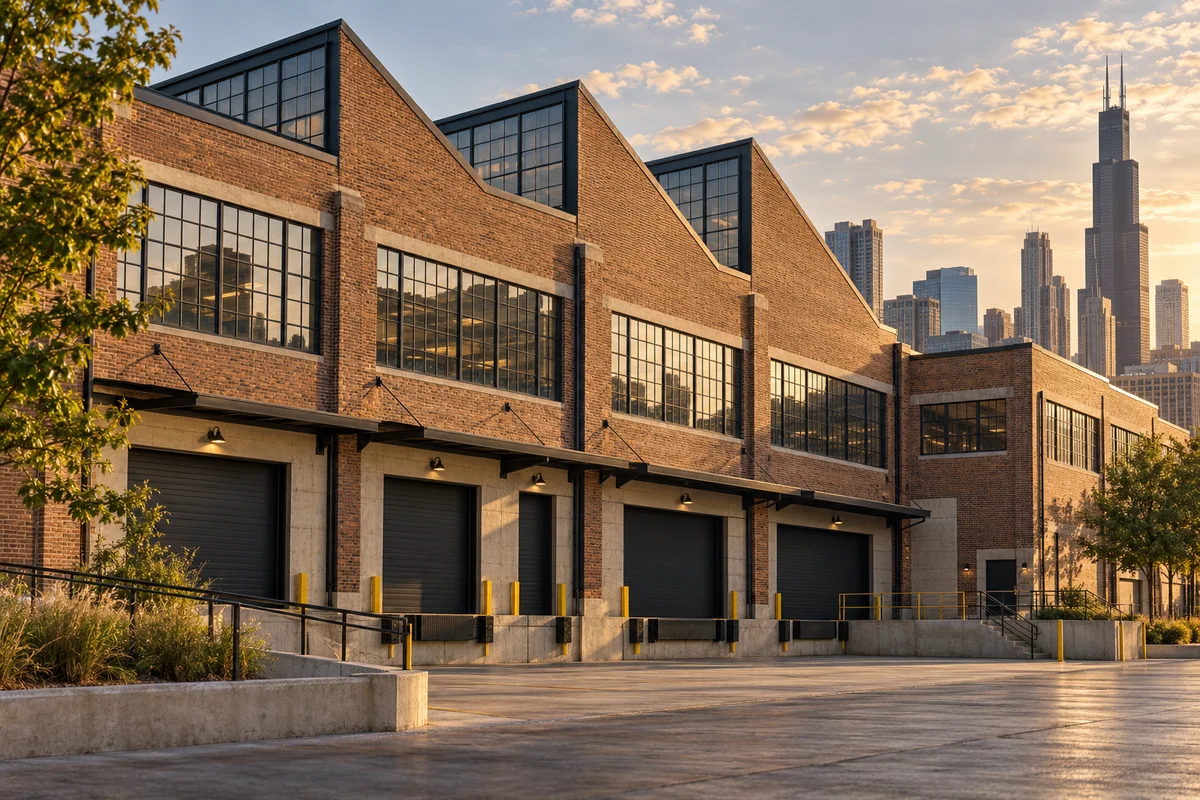
A low warehouse price per square foot can reflect functional limitations rather than a bargain. This hypothetical 40,000-square-foot Chicago-area building has restricted clear height and loading that do not match a modern high-throughput logistics user. The plan seeks a different tenant group with supported operational needs, not a cosmetic rebranding of obsolete space.
The thesis is a smaller-user or light-industrial investment at a basis that compensates for permanent limitations. The investor must distinguish work that can improve the building from structural characteristics that remain after the budget is spent.
All properties, tenants, leases, prices, costs, rates, and outcomes in this case are hypothetical. They are teaching assumptions, not market comparables, actual lender offers, or Jaken-funded transactions.
Acquisition assumptions and balanced funding
| Initial use | Amount |
|---|---|
| Purchase | $2,000,000 |
| Closing and financing costs | $60,000 |
| Physical work | $500,000 |
| Leasing capital | $150,000 |
| Opening operating liquidity | $150,000 |
| Contingency | $100,000 |
| Total uses | $2,960,000 |
| Initial selected debt | $1,200,000 |
| Required equity | $1,760,000 |
Translate physical limitations into tenant economics
At a $2 million purchase price, the initial price is $50 per square foot. Total project uses are materially higher once work, leasing, costs, and liquidity are included. That all-in basis is the relevant comparison with competing usable space, not the headline purchase metric.
The model funds $500,000 of physical work and $150,000 of leasing capital at acquisition, spent during the first two years. Assume the work improves the stipulated loading and condition but does not raise the entire building’s clear height. The budget is hypothetical; obtain engineering and contractor scope before relying on it.
The projected NOI rises from $120,000 to $250,000 over five years through defined tenant fit and execution. The investor must establish which users can operate with the remaining height, column grid, truck movement, parking, power, and fire-system constraints. An asking rent from a modern distribution center is not a useful direct assumption without a function comparison.
Prologis’s 2025 filing provides primary context for industrial competition and property function. Its institutional portfolio and rents are not comparables for this fictional older building. Prologis 2025 Form 10-K
Two financing structures
The selected illustration is $1,200,000 at 7.0%, with monthly payments, 25-year amortization and a five-year maturity. Monthly payment is $8,481; annual debt service is $101,776. Modeled principal after 60 payments is $1,093,946. The full commitment is assumed funded at closing; any restricted capital is tracked separately.
The alternative is $1,600,000 at 10.0% interest-only for 2 years, with $160,000 annual interest and $1,360,000 initial equity against the same uses. Principal remains $1,600,000 at its stipulated maturity without paydowns. The closing-cost allowance is held equal only to isolate structure; real proposals need their own fees, reserves, conditions, and approval.
The larger bridge alternative reduces initial equity by $400,000 but requires higher current interest and a two-year refinance. At that point the model has reached only $170,000 NOI, so using year-five income for takeout would be premature.
For a separate illustration, $170,000 capitalized at 9% gives approximately $1,888,889 value. At an assumed 65% LTV, that supports approximately $1,227,778 before other constraints—about $372,222 below the $1.6 million bridge principal before refinance costs. That is not an actual lending rule or appraisal; it demonstrates the timing mismatch to investigate.
The selected lower-leverage five-year structure avoids that scheduled two-year event under the teaching assumptions. Actual approval must still address in-place income, condition, tenant use, sponsor, and scope. The OCC handbook supplies commercial underwriting context. OCC CRE handbook
Five-year cash and funding model
| Year | NOI | Debt service | Recurring replacements | Raw operating cash | Opening reserve used | Cash available before owner allocation |
|---|---|---|---|---|---|---|
| 1 | $120,000 | ($101,776) | ($20,000) | ($1,776) | $1,776 | $0 |
| 2 | $170,000 | ($101,776) | ($20,000) | $48,224 | $0 | $48,224 |
| 3 | $220,000 | ($101,776) | ($20,000) | $98,224 | $0 | $98,224 |
| 4 | $240,000 | ($101,776) | ($20,000) | $118,224 | $0 | $118,224 |
| 5 | $250,000 | ($101,776) | ($20,000) | $128,224 | $0 | $128,224 |
The capital accounts are already funded within uses and are not deducted a second time in the annual cash table. The recurring replacement amount is assumed spent each year. Operating deficits first consume opening operating and contingency cash, reducing the amount returned at exit.
The five-year ramp is a simplified forecast. A real model should connect each tenant’s commencement, free rent, work, and commission with monthly payments. A building with only a few usable bays can have lumpy rather than smooth lease-up. Confirm that budgeted work produces the function assumed in the rent schedule before releasing capital.
Additional operating downside
A separate stress assumes $50,000 NOI and $250,000 additional unbudgeted capital in one stressed year. Cash after selected debt, recurring replacements, and that extra capital is ($321,776). Against the full opening operating/contingency balance of $250,000, the model uses $250,000 and requires $71,776 additional equity. This is a separate stress, not a claim that the same reserve remains intact after base-case draws.
The separate downside combines weaker NOI with another $250,000 beyond the original funded scope. That could represent an unanticipated functional or condition cost under this invented scenario; it is not a claim that a particular defect exists. The additional-equity result assumes the full initial liquidity remains available for that isolated stress.
Environmental history is a separate diligence question from physical obsolescence. Review historic use, reports, tenant activities, and recommendations with qualified advisers. EPA’s All Appropriate Inquiries material is a primary framework for environmental investigation; it does not certify this fictional property or establish automatic liability protection. EPA All Appropriate Inquiries
Do not consume the same contingency simultaneously for environmental work, tenant delivery, and operating losses without a combined cash schedule. Identify which risks are priced and which remain unresolved.
Concrete five-year exit and returns
Assume end-of-year-five sale with forward NOI of $250,000 and 2.0% selling costs. The scheduled-maturity model assumes no additional prepayment charge; actual payoff, taxes, and fees need confirmation.
| Exit calculation | Base cap | Higher-cap sensitivity |
|---|---|---|
| Exit cap | 9.0% | 10.0% |
| Gross price | $2,777,778 | $2,500,000 |
| Selling costs | $55,556 | $50,000 |
| Loan balloon | $1,093,946 | $1,093,946 |
| Net equity sale proceeds before reserve return | $1,628,276 | $1,356,054 |
| Remaining reserve returned | $248,224 | $248,224 |
| Total positive equity cash over hold | $2,269,395 | $1,997,173 |
| Total contributed equity | $1,760,000 | $1,760,000 |
| Equity multiple | 1.289× | 1.135× |
| Annual model IRR | 5.45% | 2.69% |
The base exit uses an illustrative 9% cap rate reflecting this model’s chosen pricing assumption, not a current Chicago market observation. The higher-cap sensitivity increases it to 10% while holding the operating years and terminal NOI constant. A functionally weaker or partly vacant building would require a separate income scenario too.
The return uses the full all-in equity basis, not purchase-price equity alone. It assumes positive cash is released at year-end and remaining initial liquidity returns at sale. Taxes, actual investor fees, ownership allocations, and unmodeled payoff charges remain outside these teaching returns.
The investor should compare the result with an explicit required return. A positive nominal gain over five years may still be inadequate for leasing work, noncurable limitations, and illiquidity. A low purchase price per square foot does not answer that question.
Diligence and investment decision
Build a tenant-alternative matrix before the inspection period ends. For each plausible user, record necessary height, loading, yard, power, parking, access, permitted use, and delivery condition. Identify users the property cannot serve even after improvements. A limited addressable market should affect rent, downtime, capital, and exit assumptions.
Obtain engineered feasibility for the proposed loading and building work. Separate base building repair from optional enhancement and tenant-specific work. If a limitation cannot be cured at a sensible cost, price the building for the tenant pool it actually serves rather than for an imagined modern specification.
Review the exact municipality, truck access, site configuration, shared easements, environmental history, taxes, insurance, and maintenance needs. This case asserts no universal Chicago industrial requirement or local rent trend. The subject property must supply the evidence.
Approve only if the costed plan and supported tenant demand produce an acceptable return with committed downside capital. Reprice or decline if the owner is relying on replacement-cost comparisons that ignore obsolescence, an aggressive late-stage rent, or a bridge maturity the property cannot refinance.
After closing, measure real leasing activity by qualified tenant fit rather than inquiry volume alone. Track why prospects decline, the cost to meet their requirements, collected rent, work commitments, reserve usage, and exit readiness. The investment is a functional-use decision carried through a full cash model, not an inexpensive collection of square feet.
At these assumptions, the base return is modest relative to the work and limitations modeled. An investor using a ten-percent annual hurdle would reject this price-and-scope case before considering additional uncertainty. The appropriate response is a supported change in basis or economics, not a lower exit cap selected merely to make the spreadsheet pass.