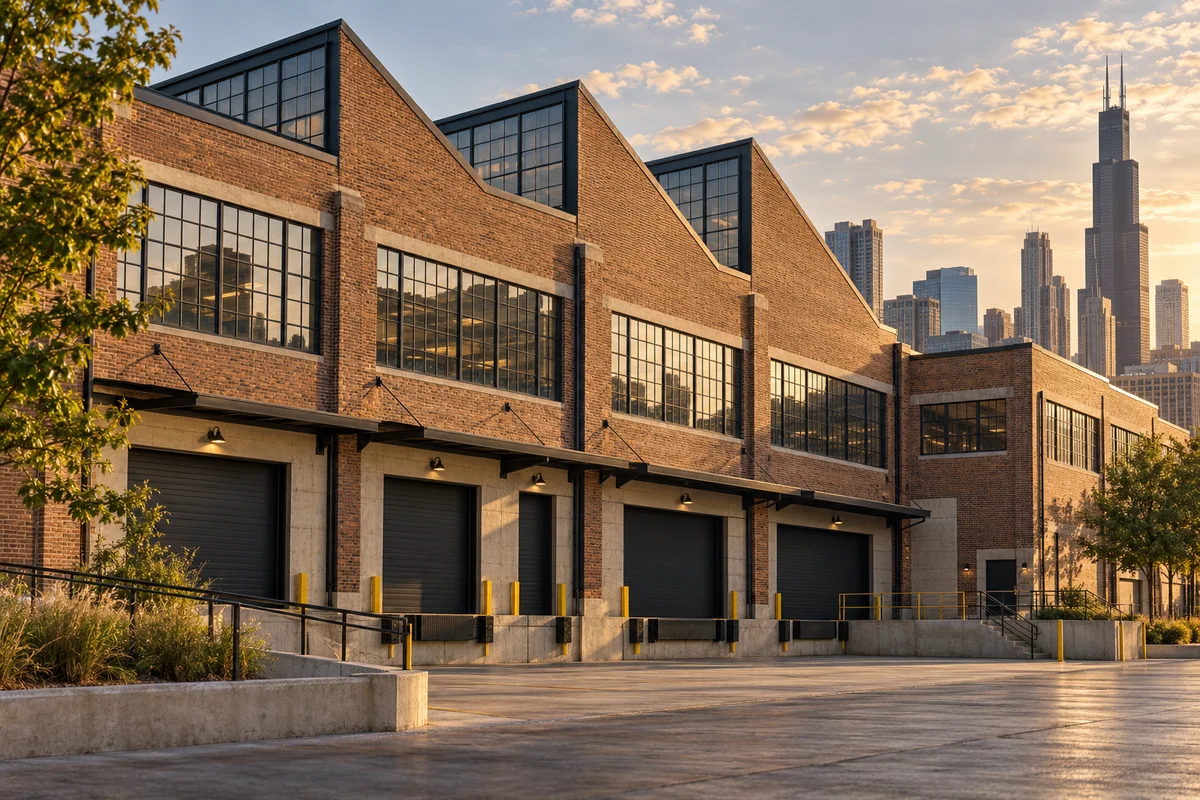
An industrial building is investable when a sufficiently deep tenant pool can use its physical features at rents that support the purchase price, operating costs, capital needs, and financing. Chicago’s freight network helps explain demand, but proximity to a highway cannot compensate for an unusable loading court, inadequate power, uncertain environmental conditions, or rent that exceeds what a replacement tenant will pay.
This guide uses original hypothetical calculations. Dollar amounts, rents, capitalization rates, and loan assumptions are illustrations, not current Chicago market quotations or lending offers.
Begin with the business inside the building
Industrial real estate houses work: receiving products, making components, repairing equipment, storing inventory, assembling orders, and dispatching vehicles. Two buildings with the same square footage may support entirely different operations. A contractor with service vans may value secure outdoor storage and drive-in doors more than high-bay racking. A distributor may need trailer circulation, multiple docks, and sufficient clearance for its equipment. A manufacturer may reject a recently renovated building because the electrical system cannot serve its machinery.
Write the target tenant’s operation in plain language before choosing comparables. State what enters the property, how it is processed, where it is stored, which vehicles move it, how many workers arrive, and when activity occurs. Then map each operational need to a measurable property characteristic.
A useful investment thesis says: “This property can serve local service businesses needing small units, individual entrances, drive-in loading, and access to customers.” “Industrial is strong” is not a thesis. It gives no basis for rejecting the wrong building.
For regional context, CMAP maps freight clusters and truck bottlenecks. Use that work to develop route questions and competing-location lists; it is not evidence that a particular parcel has legally sufficient access or a tenant willing to rent it. CMAP freight analysis
Create a functional property inventory
Collect measurements and supporting documents for the building rather than relying on broker adjectives. An inventory should include clear height at meaningful obstructions, column spacing, dock and drive-in door dimensions, truck-court geometry, driveway access, electrical service, floor condition, roof condition, fire protection, heating, office finish, parking, outdoor storage, and expansion constraints.
Record whether each item is observed, documented, or still unverified. A listing stating “heavy power” is a question to investigate. An electrician’s survey and utility confirmation may establish something useful. They do not automatically establish that a future tenant’s connected equipment and service requirements will be satisfied.
For an occupied building, ask the tenant what limits production or distribution today. Look for improvised loading, stacked inventory blocking movement, overloaded parking, or equipment occupying circulation space. Those observations can reveal deficiencies that are invisible in a rent roll. Avoid interpreting a tenant’s willingness to tolerate a limitation as evidence that all replacement tenants will accept it.
Divide deficiencies into three groups: correctable at known cost, correctable only through approvals or third parties, and physically impractical to correct. Adding lighting is different from obtaining more land for trailer turning. Treat the third category as a limitation on the tenant pool and residual value.
Underwrite the last mile
Trace the route from the nearest useful freight connection to the actual driveway. Review turns, bridge clearances, weight restrictions, traffic patterns, rail crossings, and the ability to enter without relying on another owner’s land. A regional map measures connection; a site investigation measures execution.
Test employee access as well. A site can be convenient for trucks and difficult for workers. A large parking field may look adequate until shifts overlap. A truck maneuver may interfere with the only pedestrian entrance. The property can require a circulation redesign even where the building itself is sound.
Examine ordinary operations during a realistic time window. A weekend visit may miss congestion, shared-driveway conflicts, deliveries, or adjacent businesses occupying circulation areas. Obtain the relevant recorded access and maintenance documents when a parcel uses shared improvements.
Do not assume every property in a Chicago mailing area is governed by Chicago zoning or construction rules. Confirm the actual municipality, county, service providers, and parcel boundaries first. Chicago’s official zoning atlas governs Chicago zoning classifications; suburban parcels require their own jurisdiction’s sources. Chicago zoning atlas provision
Read the lease as an operating agreement
An industrial lease is more than base rent and expiration. Abstract responsibility for roof, structure, paving, HVAC, utilities, environmental obligations, maintenance, insurance, property taxes, casualty, restoration, and surrender. Identify caps, exclusions, notice conditions, and reimbursement timing.
A lease marketed as NNN may still leave the owner paying for a roof replacement, structural failure, or unrecoverable management costs. The economic effect depends on the actual contract and applicable law. Build the model from signed lease provisions and counsel’s interpretation, not from a lease label.
Ask what remains when the tenant leaves. Specialized wiring, cranes, mezzanines, process piping, pits, or refrigerated areas can be useful improvements or expensive removal obligations. Confirm ownership of equipment, rights to remove it, restoration requirements, and any lender interests. A landlord should not value tenant-owned machinery as permanent real estate collateral without evidence.
Inspect options and purchase rights. A below-market renewal option can postpone the investor’s rent-growth thesis. A purchase option or right of first refusal can complicate a sale. A broad assignment right may change the occupant’s credit. These are underwriting inputs rather than paperwork to defer until closing.
Evaluate tenant credit separately from collateral
A solid roof does not make a weak tenant solvent. Review financial statements where available, payment history, business concentration, customer dependence, operating margins, liquidity, and the relationship between lease expense and the tenant’s business. Confirm the legal tenant, guarantor, and any corporate relationships.
For a sale-leaseback, reconstruct rent coverage after the transaction. Seller projections may show healthy earnings before a newly created rent obligation. Deduct the proposed rent, normalize owner compensation and one-time items, and consider necessary business reinvestment. A high initial yield can be compensation for rent that is difficult to sustain.
For small-bay properties, look beyond tenant count. Ten businesses serving the same construction segment can have correlated demand. Separate unit diversification from industry diversification. Ask which tenants share owners, customers, guarantors, or exposure to the same project cycle.
A large public industrial landlord’s risk disclosure can help form diligence questions. STAG discusses leasing, development, and ownership risks in its annual report. Those disclosures illustrate categories of risk; they do not establish the performance of a small Chicago building. STAG 2025 annual report
Build cash flow from leases to distributions
Start with contractual base rent by tenant and month. Add recoveries only where supported by the lease and expected to be collected. Model vacancy, free rent, collection losses, and other income explicitly. Deduct operating expenses to reach net operating income under a consistently defined convention.
Next deduct capital expenditures, tenant improvements, leasing commissions, debt service, and cash retained for reserves to estimate cash available to equity. A property can produce a respectable NOI while distributing little because an expiring tenant requires a substantial reletting package.
Keep the operating budget and capital schedule separate without forgetting either. Routine patching and a complete roof replacement have different economic timing. A repair seller calls nonrecurring may reveal a broader deferred-maintenance problem. Conversely, deducting the entire replacement project from every future year’s NOI understates recurring operations.
Check recovery accounting carefully. If the landlord records a recoverable expense and equal tenant reimbursement, include both. If the tenant directly pays the bill, do not invent both revenue and expense unless needed for a clearly defined comparison. Consistency matters when evaluating cap rates and lender cash flow.
A hypothetical acquisition model
Assume a 30,000-square-foot multi-tenant building has annual contractual base rent of $300,000 and anticipated expense recoveries of $70,000. Allow $18,000 for vacancy and credit loss. Effective income is $352,000. Operating expenses total $132,000, producing $220,000 of NOI.
The purchase price is $2.8 million. The initial NOI yield is $220,000 ÷ $2.8 million = 7.86%. This is not an equity cash yield and it excludes acquisition costs, immediate repairs, and financing.
The acquisition also requires $70,000 of transaction costs, $140,000 of roof and paving work, and $90,000 of opening reserves. Total uses are $3.1 million. An illustrative $1.82 million loan leaves $1.28 million of required equity.
Suppose annual debt service is $150,000. Subtract $15,000 of recurring capital provision from NOI and cash before additional reserve movements is $55,000. That equals 4.30% of initial equity. A sales presentation showing only the 7.86% cap rate would miss the investor’s immediate cash economics.
| Hypothetical item | Annual amount |
|---|---|
| Contractual base rent | $300,000 |
| Recoveries | $70,000 |
| Vacancy and credit loss | ($18,000) |
| Operating expenses | ($132,000) |
| NOI | $220,000 |
| Debt service | ($150,000) |
| Recurring capital provision | ($15,000) |
| Cash before further reserve movements | $55,000 |
The next question is whether $90,000 of opening reserves is enough. A reserve balance chosen because it makes the financing work is not evidence of adequacy. Build it from the monthly cash-flow trough, planned work, insurance deductibles, and leasing risks.
Stress the lease expiration before celebrating occupancy
Assume a tenant occupying 10,000 square feet expires in year two. Its base rent is $100,000 per year. Reletting takes nine months, removes $75,000 of base rent, and requires $80,000 of improvements plus $25,000 of commissions. Add $15,000 of incremental carrying expenses that are no longer recovered.
The isolated event consumes $195,000 before considering any change in replacement rent. This is an event-sizing amount, not an automatic additional deduction from the acquisition model: reconcile the $75,000 lost rent with any vacancy already included in its $18,000 allowance before calculating the incremental annual effect. It exceeds the opening reserve in the acquisition example. Some recurring cash flow may offset the shortfall, but that offset must be modeled month by month, including debt service and scheduled repairs.
Now assume the replacement tenant pays $110,000 annually. The higher stabilized rent does not erase the cash required before stabilization. Compare discounted cash flows and liquidity, not just eventual NOI. A renewal at slightly lower rent may be economically preferable if it avoids prolonged downtime and a large improvement package.
Stress two events together when they share a plausible cause. A tenant departure can coincide with market weakness and lower renewal rents. A major storm can create repair costs and interrupt rental collections. Independent one-variable sensitivities can understate the combined capital need.
Treat environmental diligence as a transaction workstream
Investigate prior uses, neighboring uses, tanks, floor drains, chemical handling, spills, and historical manufacturing. The scope should be designed by the environmental professional for the actual property and transaction. A brief site visit or seller questionnaire does not replace an appropriately scoped assessment.
EPA explains that All Appropriate Inquiries evaluates environmental conditions and potential liability, and that certain landowner protections also require continuing obligations after acquisition. An assessment is therefore part of a legal and operational process, not a blanket environmental warranty. EPA All Appropriate Inquiries
When follow-up is recommended, decide who has access, who pays, how much time is available, whether sampling may damage improvements, and what findings would trigger repricing or withdrawal. Ask the lender early about report providers, reliance, and unresolved conditions. Avoid discovering a lender’s requirements after the investigation period expires.
Environmental risk is not always a fixed cost that can be subtracted from price. Uncertain responsibility, off-site migration, business interruption, and restrictions on future use may change whether the investment thesis is feasible at any attractive price.
Review condition and safety without confusing responsibilities
A property condition review should investigate roof, structure, slab, paving, drainage, utilities, and fire protection. Operational diligence should also consider how people and machinery use the property. OSHA’s warehousing guidance identifies hazards associated with forklifts, loading, storage, and material handling. That guidance helps generate inspection questions; it does not establish the allocation of duties under a particular lease. OSHA warehousing guidance
Obtain specialists where the use requires them. A structural engineer may be needed for heavy equipment or slab distress. A fire-protection professional may need to assess the proposed storage arrangement. An electrician may identify a service limitation that affects both leasing and capital cost.
Document what was excluded from each report. A general report may not assess concealed conditions, code compliance, tenant equipment, environmental matters, or the suitability of a proposed use. Match report scopes to the thesis rather than assuming a thick report is comprehensive.
Choose debt that survives the business plan
Match loan term, amortization, reserves, covenants, prepayment, and recourse to the expected operating path. Stabilized financing may be unsuitable for a major vacancy or conversion. Bridge debt may provide flexibility but create a maturity deadline before the leasing plan is complete.
Model loan proceeds under both income and value constraints. A maximum loan-to-value percentage is not guaranteed leverage. Lower underwritten NOI, a higher interest rate, debt-yield requirements, or capital holdbacks can reduce cash delivered at closing.
For owner-users, assess the operating business and real estate together, then separate their economics for the investment decision. SBA’s 504 program supports eligible business fixed assets and excludes speculation or investment in rental real estate; program eligibility must be established for the actual transaction. SBA 504 guidance
Prepare the refinance exit before signing the initial loan. Estimate remaining lease term, tenant quality, debt balance, capital needs, and the underwritten proceeds a future lender might support. A loan maturity shortly before a major lease expiration can create a difficult refinance even when the property is currently occupied.
Build an asset plan and a sale case
Translate the acquisition thesis into tasks with owners, budgets, deadlines, and evidence of completion. Examples include obtaining utility confirmation, correcting a drainage problem, renewing a tenant, separating meters, or preparing a vacant unit for marketing. Distinguish activities that protect existing income from speculative improvements intended to attract a different tenant pool.
Track monthly collections, arrears, work orders, recovery reconciliations, leasing activity, capital spending, and reserve balances. Compare results with the acquisition model. If the tenant pool is narrower or capital costs higher than expected, update the thesis instead of preserving an obsolete forecast.
For disposition, build a buyer’s cash-flow model. Show remaining lease terms, options, landlord obligations, environmental documentation, completed work, and future capital needs. A sale price derived by capitalizing peak NOI can overstate value if a buyer immediately faces downtime and leasing costs.
Use an exit cap-rate range and explicit sale costs, then repay debt and outstanding obligations before reporting equity proceeds. Underwrite holding longer if the intended exit date becomes unattractive. Liquidity has value, and specialized buildings may need a narrower buyer search than conventional warehouses.
Build a credible leasing evidence file
For every rent comparable, record what is known about the transaction date, size, lease structure, term, concessions, improvement allowance, commissions, and delivery condition. Asking rent, signed rent, effective rent, and owner net contribution answer different questions. A broker may have strong market knowledge while still lacking permission to disclose every deal term; identify that limitation rather than invent missing data.
Create a separate list of competitive properties the target tenant could choose today. Compare their physical advantages and required tenant spending. A vacant space offered at a lower face rent may cost more after equipment, moving, utility upgrades, and business interruption. That can explain tenant behavior without proving a universal rent premium.
Ask what would cause the leasing thesis to fail. Examples include prospects needing smaller units, industrial users rejecting the loading geometry, landlords offering more concessions, or utility upgrades taking longer than assumed. Convert those possibilities into observable milestones and alternative actions.
If there are few credible transactions, widen the research carefully and explain the differences. Do not substitute an unrelated large distribution building for a small service-industrial property simply to fill a comparison table. The absence of evidence should reduce confidence and affect price or reserves.
Keep ownership incentives aligned
A property manager, leasing broker, contractor, lender, and investor can have different incentives and scopes. Define who is responsible for each decision and how costs are approved. A broker’s commission may be based on gross rent while the investor cares about cash after improvements, free rent, and vacancy. A manager may handle maintenance without overseeing a major redevelopment.
For partnership investments, establish capital-call procedures, reporting, decision rights, related-party fees, and authority for major lease concessions or sale. The physical property can perform reasonably while unclear governance creates preventable conflict. Counsel should prepare the actual agreements; the underwriting model should show the capital the partners might need to contribute.
Report performance against the acquisition thesis using both operating and cash measures. Explain whether an NOI increase came from base rent, reimbursement accounting, occupancy, temporary expense reductions, or sustainable operating improvements. Show capital spending and debt changes separately so partners can understand distributions.
At each annual review, ask whether the tenant pool, building utility, financing timeline, and exit strategy still fit. A good purchase does not eliminate the need to adapt when evidence changes.
Evaluate concentration beyond the property
Compare the acquisition with the investor’s existing exposure. Owning several small industrial properties can still produce concentration if they share the same tenant sector, lender, loan maturity year, utility dependency, or freight constraint. A diversified rent roll does not establish diversified equity risk.
Map the next three years of capital and maturities across the portfolio. A reasonable single-property reserve may be inadequate if several roofs, tenant expirations, and refinancing events coincide. Retain liquidity for the combined schedule and avoid counting the same cash as available to every asset.
For partnership ownership, communicate how this acquisition affects the broader funding position. The decision is stronger when the owner can explain both property-level downside and the ability to respond without forcing an unrelated asset sale.
The acquisition decision
Proceed when physical functionality, legal use, tenant demand, environmental findings, lease economics, and available capital support the same business plan. Reprice when a measurable deficiency has a credible remedy and the adjusted return still compensates for execution. Decline when the investment depends on an unverified critical assumption, unavailable improvement, or capital exposure the investor cannot fund.
The strongest industrial underwriting file explains both why the current tenant pays rent and who could pay rent next. That second answer connects building utility to financing resilience and long-term investment value.