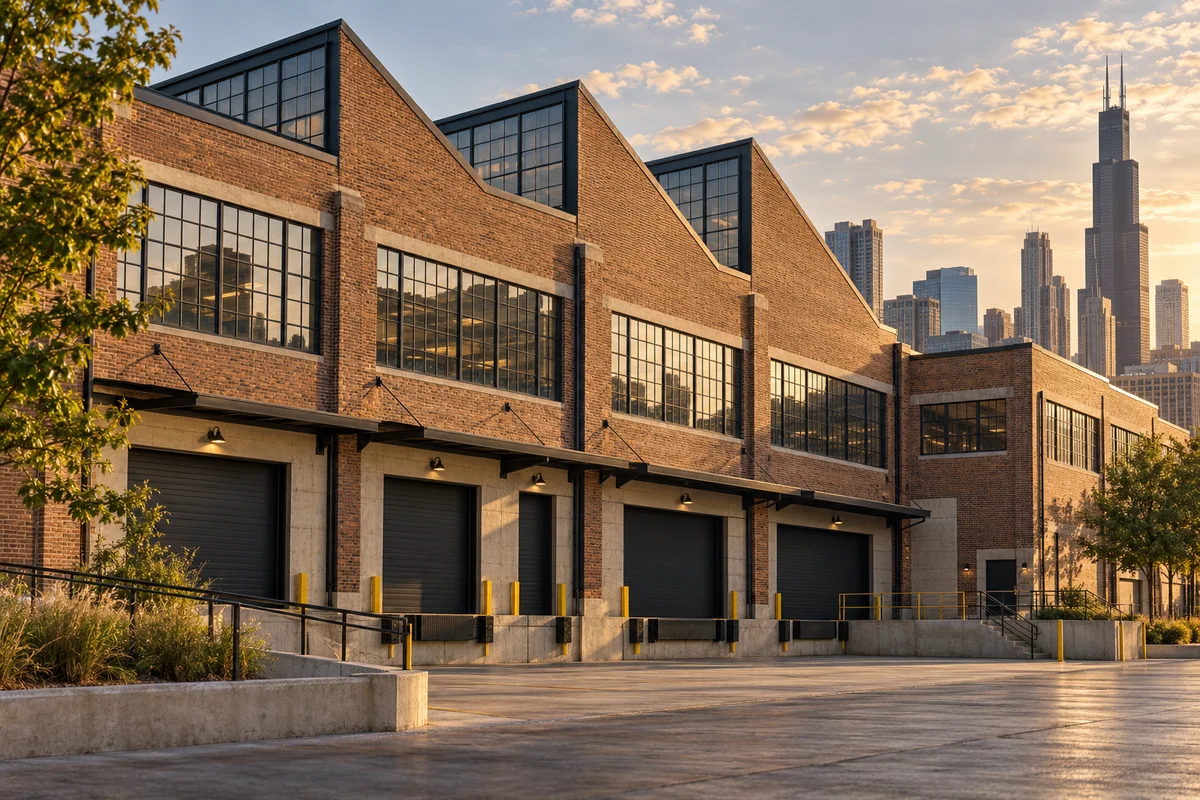
A warehouse’s discount to new construction cost does not establish that it is a bargain. The investor must determine what the existing building can earn, which deficiencies can be corrected, what correction costs, and who will lease or buy it afterward. Some older buildings serve durable users well; others remain inefficient even after expensive work.
Underwrite the property as it exists, a feasible improvement plan, and a fallback if repositioning fails. All costs, rents, and valuation assumptions below are hypothetical and do not describe current Chicago market pricing.
Identify the form of obsolescence
Separate physical deterioration from functional limitations and location disadvantages. A worn roof is a different problem from low clearance, an awkward column grid, inadequate loading, insufficient power, or a constrained site.
A building can be physically sound but poorly suited to the intended tenant. Conversely, an older building with modest height can be valuable to local service users if access, unit size, power, and price fit their operations. Avoid defining quality only through age or modern warehouse specifications.
Create a deficiency register with evidence, affected tenant groups, remedy, cost, time, approvals, and remaining limitations. Classify each item as documented, preliminary, or unresolved. A purchase discount should be compared with the full register rather than one visible repair.
Ask whether the thesis is continued use, selective improvement, subdivision, expansion, conversion, or redevelopment. Different plans require different evidence and capital. A model that changes strategy whenever a problem emerges may not have a coherent acquisition basis.
Establish the as-is tenant market
Identify credible users for the current configuration. Research actual competing spaces and leases, including concessions, improvements, delivery condition, and time to occupancy. An asking rent from a modern distribution building is not a direct comparable for a small older industrial property.
Interview brokers about rejected prospects and required compromises. Ask which deficiency most often prevents leasing. The answer may reveal that a low-cost cosmetic program will not solve the actual problem.
Public industrial-owner risk disclosures discuss competition, incentives, and reletting costs. Those categories are useful for framing the analysis, while actual local evidence must establish the property’s rent and demand. STAG Industrial 2025 annual report
Underwrite a realistic rent for the building’s utility. A discount can make an older asset attractive when it supports a lower-rent tenant profitably. The investor does not need to transform every building into a modern institutional product.
Test the proposed remedy professionally
Obtain engineering, architectural, contractor, utility, and legal input appropriate to the work. Moving a wall, adding a loading opening, upgrading electrical service, or changing a structural element can involve connected systems and approvals.
For Chicago properties, the official construction-code resources provide the starting point for existing-building work. Ask professionals to establish the actual scope and applicable requirements rather than assume a retrofit is exempt or universally requires a full rebuild. Chicago Construction Codes
Include design, permits, professional fees, testing, contingency, tenant coordination, and downtime. The contractor’s visible-work estimate may not capture the investment’s full cost.
Determine whether the project depends on off-site rights, utility capacity, neighboring consent, or unavailable land. A physically possible solution is not necessarily within the owner’s control or economically executable.
Compare three complete scenarios
The as-is scenario should include necessary repairs and realistic leasing. The selective-improvement scenario should target changes with evidence of tenant value. The major-repositioning scenario should include its full capital, timeline, and failure case.
Use the same operating and valuation conventions across scenarios. Do not compare stabilized NOI after improvement with current NOI before ordinary normalization, or compare an unlevered yield with a levered return.
Model cash timing monthly during vacancy and construction. A project can create value at stabilization yet require more interim equity than the investor can supply. Distinguish committed debt, conditional draws, holdbacks, and equity.
The fallback should explain what remains if the preferred tenant does not sign or an approval is denied. Some spending can be reused; some may be sunk. Identify both.
A hypothetical purchase comparison
Assume a 40,000-square-foot warehouse costs $2 million. Closing costs are $60,000, necessary repairs are $240,000, and opening reserves are $100,000. Total initial uses are $2.4 million. At supportable stabilized NOI of $180,000, the NOI yield on those uses is 7.5% before financing.
A retrofit adds $500,000 of construction, $80,000 of professional and contingency cost, and $70,000 of incremental carry and delayed income, bringing the total basis to $3.05 million. If stabilized NOI rises to $250,000, the corresponding yield is 8.20%.
The incremental NOI is $70,000 against $650,000 of incremental economic cost, a simplified 10.77% stabilized incremental yield. That is not an IRR and does not account for the timing or risk of future cash flows.
If the achievable NOI is only $215,000, the full-basis yield is 7.05%, below the as-is scenario. A successful construction project can therefore be an unsuccessful investment when the rent gain is insufficient.
Avoid misusing replacement cost
Replacement cost can provide useful context, particularly where an existing building offers practical utility that would be expensive to recreate. But the buyer is acquiring the existing property’s income and constraints, not a claim on a new building.
Land configuration, infrastructure, entitlement, age, design, and functional utility can differ. A comparison saying the price is “half of replacement cost” may omit the new property’s higher efficiency, different location, or lower near-term capital need.
Ask which prospective tenant or buyer values the existing improvements. If the probable exit is demolition or substantial conversion, the value of the old building may be limited despite its historical construction expense.
Do not add retrofit cost automatically to value. Value depends on supportable income, demand, risk, and buyer alternatives. A $500,000 project can add more, less, or no recoverable value depending on its result.
Inspect concealed and historical issues
Older buildings may have additions, changed floor elevations, undocumented alterations, concealed deterioration, or specialized former uses. Review permits, plans, maintenance, prior reports, and actual conditions through qualified professionals.
Environmental history should be investigated separately from physical condition. EPA’s All Appropriate Inquiries framework is relevant to acquisition assessment and potential liability analysis. A visually clean warehouse may have a history requiring follow-up. EPA All Appropriate Inquiries
If the project involves excavation, pits, utility trenches, or demolition, tell the environmental team. The capital plan can change the significance of an existing condition and the cost of handling material.
Identify inaccessible areas and unresolved scope before the investigation deadline. A larger contingency can help fund uncertainty but cannot make a technically or legally infeasible plan workable.
Align leases and construction
For occupied properties, review access, interruption, relocation, consent, rent abatement, and restoration provisions. The owner cannot assume it can perform disruptive work without consequences.
For new leases, define delivery scope, specifications, approvals, responsibility, rent commencement, outside dates, and delay remedies through counsel. A tenant’s promised higher rent should not be valued as stabilized cash before the landlord can deliver.
Ask whether the improvements are general-purpose or tenant-specific. A reusable loading upgrade differs from specialized process infrastructure. Tenant credit and lease duration should influence how much capital the investor commits.
If a tenant contributes, model when the cash is received. A post-opening reimbursement does not finance early contractor deposits. The owner still needs working capital.
Measure the remaining limitation after the work
Write a post-project specification and compare it with the target tenant’s requirements. A renovated older warehouse may still have lower clearance, more columns, limited loading, or a constrained yard. The investor should not use modern-building rent merely because the capital program is expensive.
Ask brokers to evaluate the completed concept before construction. Their feedback should identify which prospective tenants become viable and which remain excluded. If the largest objections survive the project, reconsider scope or price.
A hypothetical $400,000 program that improves appearance but leaves a critical loading constraint may support retention without creating the forecast new rent. That can still be worthwhile, but the investment thesis must reflect preservation rather than transformation.
For terminal value, disclose the remaining limitations and future capital. A buyer will evaluate the completed asset’s utility, not reimburse the seller’s historical spending automatically. Maintaining this distinction helps prevent the sponsor from treating sunk cost as proof of value.
Retain the post-project specification with leasing materials so brokers market the building’s actual capabilities rather than the modernization budget.
Connect financing and exit
Present the lender with the as-is condition, scoped work, capital schedule, leasing evidence, and fallback. Maximum leverage may be constrained by current income, reserves, completion risk, or the appraised condition.
Model refinancing after the project using plausible stabilized income and remaining lease term. A bridge loan’s maturity can arrive before cash rent stabilizes if approvals or leasing slip.
At sale, buyers will price future capital and residual utility. Provide documentation of completed work and remaining limitations. A refreshed exterior does not erase a structural grid or site constraint.
Proceed when the complete basis and credible tenant market justify the risk. Reprice where the building works at lower rent or with fewer improvements. Decline when the discount is smaller than the economic burden of making the property useful.