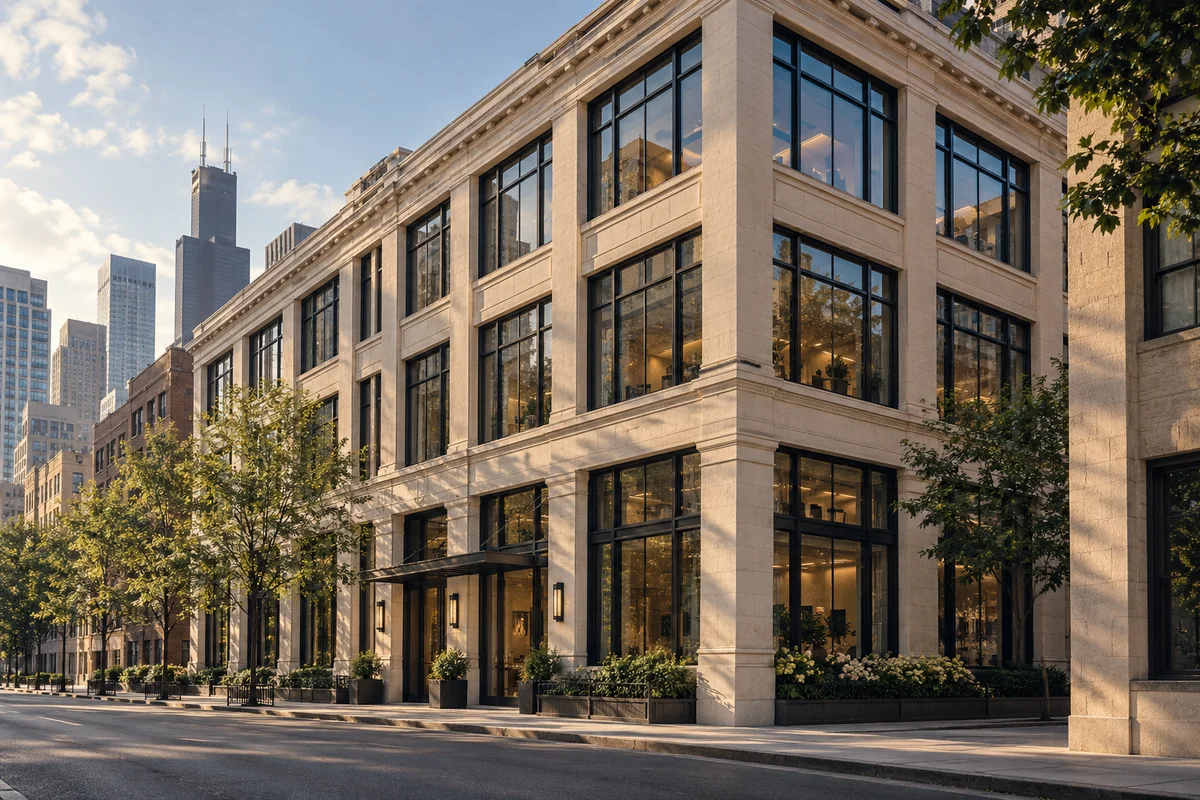
A low price for an obsolete building can be the smallest part of an adaptive-reuse investment. The relevant comparison is the cost of delivering a lawful, useful new asset, including the months without rent. This hypothetical case converts an underused commercial building into a different commercial use supported by an assumed tenant plan.
The case does not assume a residential conversion, special incentive, approval, or actual address. The investment thesis is conditional on professional feasibility review, supported tenant demand, complete scope, and committed capital. Until those conditions are established, the project is an option under investigation rather than a stabilized investment.
All properties, tenants, leases, prices, costs, rates, and outcomes in this case are hypothetical. They are teaching assumptions, not market comparables, actual lender offers, or Jaken-funded transactions.
Acquisition assumptions and balanced funding
| Initial use | Amount |
|---|---|
| Purchase | $2,500,000 |
| Closing and financing costs | $150,000 |
| Physical work | $3,000,000 |
| Leasing capital | $200,000 |
| Opening operating liquidity | $400,000 |
| Contingency | $500,000 |
| Total uses | $6,750,000 |
| Initial selected debt | $3,000,000 |
| Required equity | $3,750,000 |
Test the proposed asset, not the existing shell alone
Assume an acquisition price of $2,500,000 and $3,000,000 physical conversion scope. Leasing and initial tenant capital add $200,000, with substantial operating liquidity and contingency. The acquisition price alone therefore gives a misleading impression of basis. Every structural, mechanical, access, safety, utility, and tenant delivery requirement must be assigned to the budget or explicitly excluded and tested.
The case projects negative NOI in years one and two while the building incurs operating expenses without adequate rent. NOI then reaches $300,000, $550,000, and $650,000. At terminal operations, hypothetical $1,000,000 effective revenue less $350,000 expenses yields $650,000 NOI. This assumes the new use is complete and the tenant plan works; it is not evidence about Chicago market rent or entitlement timing.
A physical feasibility team should compare the existing structure with the proposed occupancy, including floor geometry, circulation, systems capacity, loading, environmental issues, accessibility, and code requirements. A desirable use can be physically possible and still uneconomic at the required delivered cost.
For a City of Chicago address, the city’s construction-code information is a primary starting point. It does not establish that this hypothetical proposal is permitted or that approval can be obtained on a stated schedule. Review zoning and other applicable requirements separately with qualified professionals. Chicago construction codes
Two financing structures
The selected illustration is $3,000,000 at 8.0%, with monthly payments, 25-year amortization and a five-year maturity. Monthly payment is $23,154; annual debt service is $277,854. Modeled principal after 60 payments is $2,768,218. The full commitment is assumed funded at closing; any restricted capital is tracked separately.
The alternative is $4,000,000 at 10.5% interest-only for 3 years, with $420,000 annual interest and $2,750,000 initial equity against the same uses. Principal remains $4,000,000 at its stipulated maturity without paydowns. The closing-cost allowance is held equal only to isolate structure; real proposals need their own fees, reserves, conditions, and approval.
The larger interest-only alternative preserves $1,000,000 initial equity but has a three-year balloon, when projected NOI is only $300,000. A plan that assumes refinancing against year-five $650,000 at that earlier date fails the timing test. The short structure needs a credible extension, paydown, or other exit based on actual conditions.
The selected amortizing loan requires more equity and still carries debt service during negative operating years. It is a teaching comparison, not a representation that a lender would fully fund a speculative conversion at closing. An actual construction loan needs a monthly draw, interest, retainage, and completion schedule.
OCC guidance supplies primary context for construction budgeting, disbursement controls, repayment, and collateral risk. Use it to ask better questions rather than infer lender approval. Funding the purchase does not establish funding for every later project obligation. OCC CRE handbook
Five-year cash and funding model
| Year | NOI | Debt service | Recurring replacements | Raw operating cash | Opening reserve used | Cash available before owner allocation |
|---|---|---|---|---|---|---|
| 1 | ($50,000) | ($277,854) | ($30,000) | ($357,854) | $357,854 | $0 |
| 2 | ($25,000) | ($277,854) | ($30,000) | ($332,854) | $332,854 | $0 |
| 3 | $300,000 | ($277,854) | ($30,000) | ($7,854) | $7,854 | $0 |
| 4 | $550,000 | ($277,854) | ($30,000) | $242,146 | $0 | $242,146 |
| 5 | $650,000 | ($277,854) | ($30,000) | $342,146 | $0 | $342,146 |
The $3,000,000 physical and $200,000 leasing accounts are funded in initial uses and spent over years one through three. They are not deducted a second time in the cash table. The recurring $30,000 replacement amount is a separate annual provision assumed spent in that year.
The $900,000 opening operating and contingency pool covers modeled negative cash first. If the raw deficit exceeds that pool, the model records additional equity rather than hiding a negative balance. The annual schedule must be supplemented with monthly commitments, draws, payments, taxes, insurance, debt service, and tenant commencement dates.
A particularly useful comparison is the cost of stopping after each stage. Before major demolition, determine the obligations already committed, costs to secure and maintain the property, and likely sale or alternative-use value. That decision can differ sharply after removing systems or signing tenant delivery obligations. A sunk acquisition cost should not force an uneconomic next expenditure.
Additional operating downside
A separate stress assumes ($100,000) NOI and $900,000 additional unbudgeted capital in one stressed year. Cash after selected debt, recurring replacements, and that extra capital is ($1,307,854). Against the full opening operating/contingency balance of $900,000, the model uses $900,000 and requires $407,854 additional equity. This is a separate stress, not a claim that the same reserve remains intact after base-case draws.
The separate stress assumes negative $100,000 NOI and $900,000 of additional capital beyond the base program. It is deliberately a combined funding challenge. The deficit calculation uses the opening reserve only for this isolated scenario, not after also assuming it funded the base transition.
Environmental investigation is important when altering an older commercial asset or disturbing materials and soil. EPA’s All Appropriate Inquiries materials describe a federal diligence framework, not a guarantee of a clean building or automatic protection from all liability. Qualified environmental and legal advisers must evaluate the specific site and intended work. EPA All Appropriate Inquiries
Test delay and scope together. Six more months of design or approvals can extend carrying costs, change tenant commitments, and require an interest-rate or maturity solution. A construction contingency does not automatically pay every operating and financing consequence of delay.
Concrete five-year exit and returns
Assume end-of-year-five sale with forward NOI of $650,000 and 3.0% selling costs. The scheduled-maturity model assumes no additional prepayment charge; actual payoff, taxes, and fees need confirmation.
| Exit calculation | Base cap | Higher-cap sensitivity |
|---|---|---|
| Exit cap | 8.0% | 9.0% |
| Gross price | $8,125,000 | $7,222,222 |
| Selling costs | $243,750 | $216,667 |
| Loan balloon | $2,768,218 | $2,768,218 |
| Net equity sale proceeds before reserve return | $5,113,032 | $4,237,337 |
| Remaining reserve returned | $201,438 | $201,438 |
| Total positive equity cash over hold | $5,898,763 | $5,023,068 |
| Total contributed equity | $3,750,000 | $3,750,000 |
| Equity multiple | 1.573× | 1.339× |
| Annual model IRR | 9.57% | 6.08% |
The sale assumes a completed commercial conversion with $650,000 supportable forward NOI. Selling costs are 3%, and the amortizing loan’s scheduled balloon is deducted. The higher-cap sensitivity changes only pricing. An unfinished conversion needs a different value method, remaining-cost analysis, and liability review.
The equity basis includes the whole delivered plan and any base-case additional contribution. The return assumes year-end release of positive cash and returns only unused opening liquidity. It excludes income taxes and negotiated ownership allocations. A large gross value increase is not the same as a strong return after construction, carrying costs, and time.
Prepare a sale file documenting approvals, completion, warranties, tenant delivery, collections, operating costs, and continuing obligations. A buyer should be able to distinguish completed value from a remaining promise that still requires capital.
Diligence and investment decision
Use staged commitments where feasible. Establish a feasibility milestone before unconditional acquisition, a complete-budget milestone before construction, and a tenant and funding milestone before major discretionary scope. Each gate needs an explicit stop or reprice option, subject to actual contracts.
Compare conversion with continued existing use, a smaller repositioning, sale, and demolition or redevelopment only where those options are actually lawful and feasible. A compelling architectural concept must compete with other uses of capital.
Approve only if the new use, full scope, monthly funding, lender structure, downside contribution, and all-in return are supportable. During execution, report committed costs, remaining work, contingency, approvals, lease milestones, liquidity, and maturity together. The decision is whether the next capital dollar advances a fundable investment, not whether a rendering makes the old building look promising.