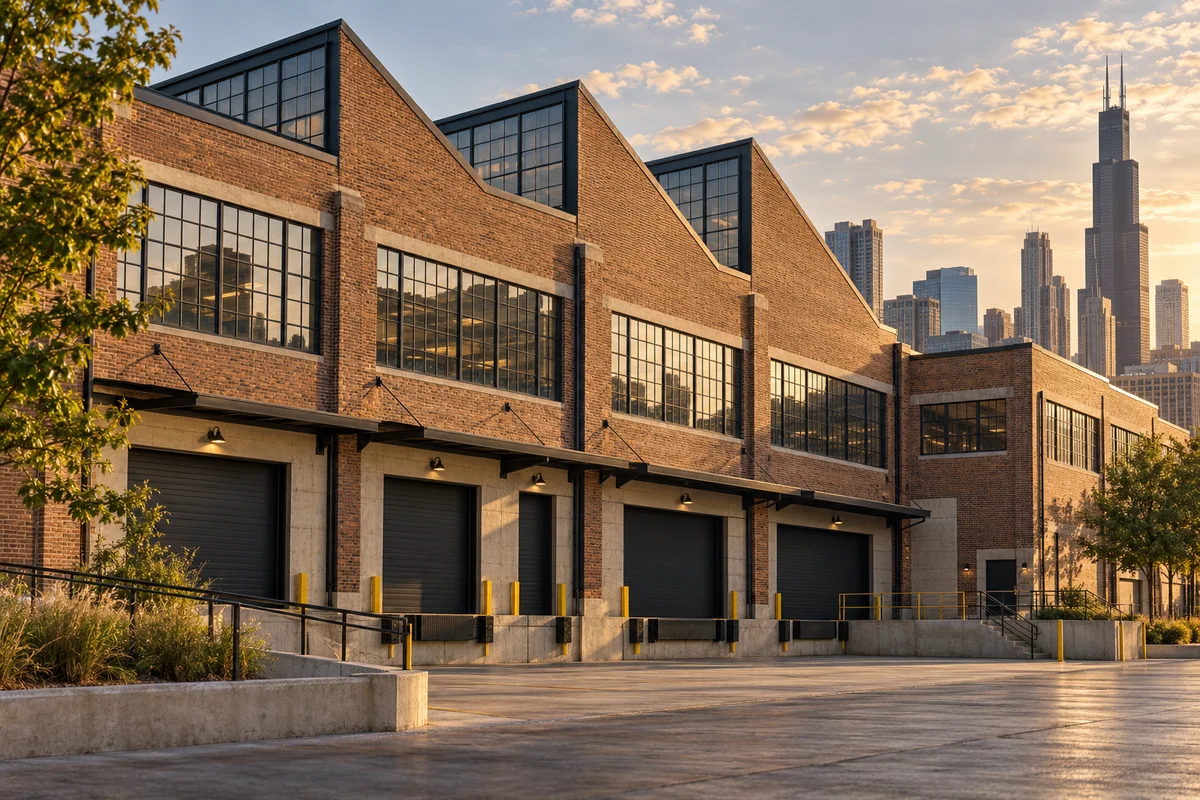
An industrial property next to railroad tracks is not necessarily rail-served, and a rail-served property is not automatically more valuable to every tenant. Investors should verify the actual connection, rights, service, maintenance, operating fit, and customer demand before assigning a rail premium.
The same discipline applies to intermodal and freight-corridor claims. Evaluate the tenant’s complete logistics chain and the property’s usable role in it. This guide does not state current rail service, tariffs, terminal capacity, or travel times for any parcel.
Distinguish adjacency, access, and service
Ask whether tracks physically connect to the site, whether the connection is operational, who owns each component, and which agreements govern its use. Confirm facts with the appropriate rail parties and qualified specialists.
A disconnected or inactive spur may be a redevelopment question rather than a current operating asset. A visible rail line can also create a barrier or crossing constraint for a property that receives no direct service.
Obtain relevant agreements, maps, maintenance records, service information, and correspondence. Ask who can terminate, suspend, alter, or require work under the arrangements. A seller’s statement that service “could be restored” is an unverified proposal until investigated.
Record the exact property and legal rights. Track may cross other parcels or depend on shared facilities. Counsel and the survey team should establish what rights transfer with the acquisition and what obligations remain.
Union Pacific’s development process includes engineering review, a track agreement, construction coordination, and inspection before service. Other carriers and parcels need their own confirmation. Carrier development process
Define the tenant’s logistics need
Ask what materials move, in which quantities, at what frequency, and with what timing and handling needs. A manufacturer receiving bulk inputs may have a different requirement from a distributor moving packaged goods.
Understand whether rail is essential, optional, or irrelevant to likely users. A feature with high replacement cost can still add little rent if the local tenant pool does not need it. Conversely, a verified connection can be central to a specialized operation.
Consider handling, storage, unloading, equipment, labor, safety, and inventory implications. The transport rate alone does not establish total logistics cost. The property must support the full operation.
CMAP’s freight analysis provides regional context for clusters, intermodal activity, and bottlenecks. Use it to identify relevant locations and questions; it is not a service commitment for a particular property. CMAP freight analysis
Verify condition and capital obligations
Have the relevant specialists assess the track, switches, loading areas, drainage, crossings, clearances, and other components needed for the proposed service. The investor should not infer operational condition from an aerial image.
Determine who inspects, maintains, repairs, replaces, and funds each part. Shared infrastructure can create obligations or dependencies beyond the acquired land. Ask how costs are allocated and what happens if another user stops participating.
Include reactivation or upgrade work where required. A preliminary concept should not be treated as a fixed bid or guaranteed service date. Equipment, third-party approval, construction access, and coordination can affect the schedule.
For Chicago parcels, use the official zoning framework to evaluate the proposed site activity and property-specific conditions. Rail service does not itself authorize every material, process, outdoor storage arrangement, or operating intensity. Chicago zoning atlas provision
Examine road and employee access too
A rail-oriented tenant still needs trucks, employees, emergency access, and utilities. Review the site’s connections and circulation as an integrated system. Rail movements can conflict with internal routes or nearby crossings.
Trace the actual truck route to useful freight connections. Intermodal proximity can be offset by queues, indirect roads, restrictions, or terminal procedures. Ask the tenant for operational evidence where available.
Consider labor access and shift timing. A site that is attractive for freight may be difficult to staff. The investor should understand the tradeoff without assuming a universal rent adjustment.
Regional transportation plans provide context for future connections and constraints, but proposed improvements should remain separate from current operating facts. CMAP Regional Transportation Plan
A hypothetical rail-premium calculation
Assume a specialized tenant offers $330,000 annual base rent for a building with usable rail service. A nonrail tenant could support $280,000. The gross annual premium is $50,000.
The illustrative rail-related owner costs are $15,000 annual maintenance and administration, plus an initial $400,000 rehabilitation and connection program. Net annual premium before other differences is $35,000. A simplified stabilized incremental yield is $35,000 ÷ $400,000 = 8.75%.
Now add $60,000 of professional, approval, and contingency cost and $40,000 of incremental delay, bringing total incremental exposure to $500,000. The same annual premium is 7%. Neither figure is an IRR, and neither includes tenant credit, service risk, future major work, or exit value.
If the specialized tenant leaves and the next user pays only nonrail rent, the improvement may not sustain the original premium. The investment decision should include that re-leasing case rather than treating the current tenant’s willingness to pay as perpetual property income.
Assess service and counterparty dependence
Ask the logistics team which service characteristics are critical and how changes would affect operations. Identify alternatives if service is delayed, reduced, interrupted, or no longer economical.
Do not promise a service level based solely on historical use. Obtain current information from the responsible parties and distinguish binding terms from preliminary indications. The investor should know which assumptions depend on counterparties outside its control.
Review tenant credit in the context of those dependencies. A business whose economics require a particular transport arrangement may weaken if costs or service change. Property and tenant risks can be correlated.
The lease should address responsibilities and consequences through counsel. A landlord should not inadvertently guarantee a third party’s performance or an undefined operational standard.
Investigate environmental and use history
Rail-served industrial properties may have historical activities relevant to environmental investigation. The actual past use, materials, maintenance, spills, fill, and neighboring operations should be reviewed by qualified professionals.
Do not infer contamination merely from the presence of tracks, or assume a clean site because no issue is visible. Give the environmental team the proposed work and operating plan, including excavation, storage, and handling.
Use findings to evaluate capital, permissions, restrictions, lender requirements, and ongoing obligations. A defined condition may be manageable; an unresolved issue can affect whether the intended operation is feasible.
Model the fallback property
Underwrite the building without rail-dependent rent. Identify nonrail tenants, necessary adaptations, downtime, improvements, commissions, carrying costs, and residual capital obligations. Determine whether track removal or continued maintenance would be required or useful.
A property may be attractive because a specialized tenant has a long lease, but the investor should understand what happens at expiration or default. Loan maturity and lease term should be evaluated together.
For sale, distinguish investors buying the current income from owner-users valuing operating utility. The buyer pool and diligence requirements may be narrower than those for a conventional warehouse. Avoid assigning a universal liquidity discount without evidence, but allow realistic marketing time.
Compare a rail-dependent tenant with a truck-only fallback
Create a logistics cost comparison with the prospective occupier and appropriate specialists. Include line-haul or service cost, handling, inventory, storage, labor, equipment, schedule reliability, and the road portion of the trip. A lower transport rate on one leg does not establish lower total cost.
For a hypothetical user, rail-related savings of $120,000 annually might be offset by $35,000 of additional handling, $25,000 of inventory carrying, and $20,000 of site maintenance or equipment. Net benefit would be $40,000 under those assumptions. That can support a different rent than the gross $120,000 figure implies.
The landlord should not treat the tenant’s internal estimate as a property appraisal. Ask whether other credible users would achieve similar benefits, whether the assumptions require a specific supplier or customer network, and how those relationships could change. The more private and business-specific the advantage, the more the investment depends on tenant credit rather than broad residual demand.
Also compare interruption responses. Can the user shift temporarily to trucks, at what cost, and for how long? Does the site have loading, parking, access, and storage to support the alternative? A fallback transport mode can require different real estate features.
Use the findings to evaluate lease structure and reserves. If rent depends on uninterrupted third-party service, the investor should understand actual contractual obligations and remedies rather than imply a guarantee. If the building can serve a truck-only tenant at lower rent, model that supportable rent and the adaptation cost at expiration.
Retain the operator’s assumptions, date, limitations, and source of information. Revisit them when the tenant, commodity, service, or infrastructure changes. A rigorous logistics comparison is useful because it explains a rent premium and its fragility; it should not become a permanent assertion that rail adjacency makes every industrial property more valuable.
Record which service statements are current commitments and which are preliminary discussions requiring further approval.
Keep the evidence file current
Retain agreements, rights, maps, condition reports, completed work, maintenance records, service correspondence, and tenant-use analysis. Update the file when operations or arrangements change.
Proceed when usable service, credible demand, legal rights, and full costs justify the investment. Reprice where the rail feature is conditional or useful only to a narrow market. Decline when the acquisition price requires a premium the owner cannot substantiate or sustain.